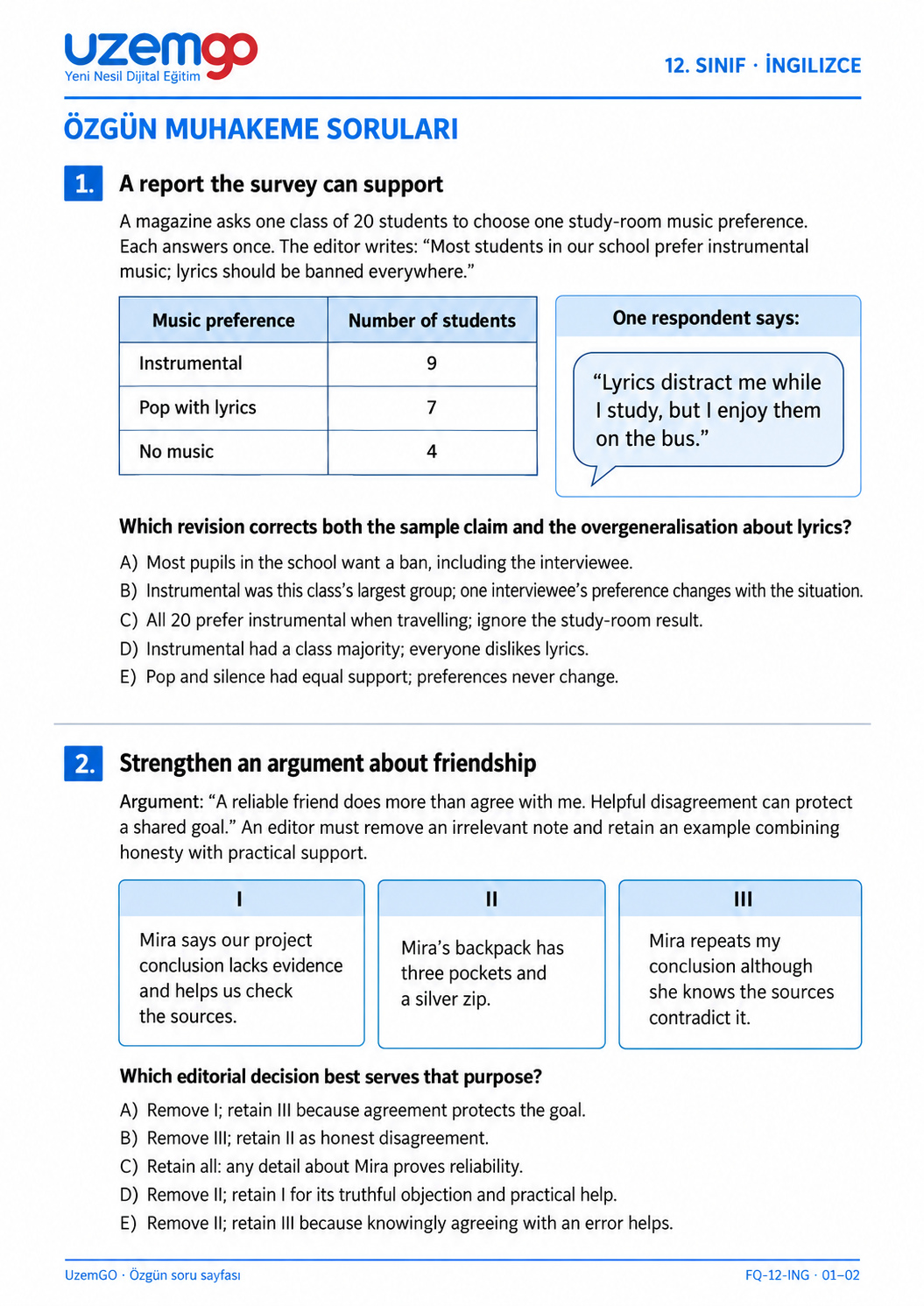
Görsel yüklenemedi. Aşağıdaki erişilebilir metinden çalışabilirsin.
Yakından okumak için + düğmesini kullan. Bu sayfanın cevapları aşağıda.
Bu sayfanın sorularını metin olarak oku
1. A report the survey can support
A magazine asks one class of 20 students to choose one study-room music preference. Each answers once. The editor writes: “Most students in our school prefer instrumental music; lyrics should be banned everywhere.”
Görseldeki bilgiler: Anket tablosu: Instrumental 9; Pop with lyrics 7; No music 4. Altında görüşme kartı: One respondent says, “Lyrics distract me while I study, but I enjoy them on the bus.”
Which revision corrects both the sample claim and the overgeneralisation about lyrics?
Most pupils in the school want a ban, including the interviewee.
Instrumental was this class’s largest group; one interviewee’s preference changes with the situation.
All 20 prefer instrumental when travelling; ignore the study-room result.
Instrumental had a class majority; everyone dislikes lyrics.
Pop and silence had equal support; preferences never change.
2. Strengthen an argument about friendship
Argument: “A reliable friend does more than agree with me. Helpful disagreement can protect a shared goal.” An editor must remove an irrelevant note and retain an example combining honesty with practical support.
Görseldeki bilgiler: Üç not kartı. I: Mira says our project conclusion lacks evidence and helps us check the sources. II: Mira’s backpack has three pockets and a silver zip. III: Mira repeats my conclusion although she knows the sources contradict it.
Which editorial decision best serves that purpose?
Remove I; retain III because agreement protects the goal.
Remove III; retain II as honest disagreement.
Retain all: any detail about Mira proves reliability.
Remove II; retain I for its truthful objection and practical help.
Remove II; retain III because knowingly agreeing with an error helps.
3. What does the listener revise?
“I once judged an album after its opening track. This time, the first song still did not appeal to me, but I listened to the whole album. A quiet passage near the end changed how I heard the opening: it now sounded like a question the later music was answering.”
What has changed in the listener’s approach?
The listener now considers how parts relate to the whole before settling on a judgement.
The listener has decided that opening tracks should be removed from albums.
The listener now enjoys every song equally because the album has a quiet passage.
The listener rejects personal reactions and judges only the popularity of an album.
The listener believes the last track always proves the first impression correct.
4. Support without taking control
Nora says, “I can listen while you work through the decision, but I cannot choose your course for you.” Her friend replies, “That is what I need: someone to help me examine my reasons, not someone to make the choice.”
Which statement captures their agreement?
Support is useful only when one friend takes full responsibility for the other’s decisions.
Listening prevents people from reaching any decision of their own.
Their friendship depends on choosing identical courses.
They distinguish helping someone think from replacing that person’s judgement.
Nora has refused all involvement in the conversation.
5. A fair review of a rehearsal
Your group tried two rehearsal methods. Recording short sections helped members notice timing problems. Repeating the whole piece improved continuity, but some difficult sections received little attention. No performance result is available yet.
Write a three-sentence review that gives one strength of each method and proposes a combined plan without claiming that either method has already improved a public performance.
6. An exception that matters
“You may share the rehearsal recording within our group, provided that everyone whose voice appears has agreed. Permission to rehearse together is not permission to post the recording publicly.” One member agrees to internal sharing but not public posting.
Which action is consistent with the message?
Post it publicly because joining a rehearsal implies unlimited permission.
Check every recorded person’s agreement before internal sharing and do not treat it as permission for public posting.
Share it internally without asking anyone because the audience is small.
Ignore the member’s limit because most group members prefer publicity.
Assume that one person’s agreement covers all recorded voices.
7. The purpose of a concession
“A familiar song can help a new group feel at ease. Yet familiarity should be a starting point, not a limit: inviting members to explain an unfamiliar choice may reveal experiences the group has never discussed.”
What is the function of the first sentence?
It proves unfamiliar music has no place in a group activity.
It lists the exact songs all members must select.
It criticises members for having shared experiences.
It concludes that discussion should stop once everyone feels comfortable.
It recognises a benefit before arguing that the group should move beyond it.
8. Complete a respectful boundary
A close friend asks you to join a live call tonight. You have already promised to help your younger brother prepare for a presentation. You want to keep that promise and still arrange a conversation with your friend tomorrow afternoon.
Complete: “I would like to talk, but tonight ______. Could we ______ instead?” Explain how the response shows both care and a boundary.
9. Which evidence supports the claim?
Claim: “Disagreement can improve a shared project when people explain the reasons behind their preferences.”
Which example provides the strongest support?
Two friends choose the same cover because neither wants a discussion.
A group accepts the loudest member’s choice without asking why.
One member explains that small lettering is hard to read; another proposes a clearer layout, and the group revises the cover.
The group lists everyone’s favourite colour but makes no connection to the project.
One member leaves after being told that all disagreement shows disloyalty.
10. What can the survey show?
After an optional lunchtime music session, the organiser asks only the pupils who stayed until the end for feedback. Most describe it as enjoyable. The report says, “All pupils in the school prefer this activity to other lunchtime options.”
Which revision is justified?
The session was unpopular because some pupils did not attend.
Feedback from participants is useless unless every pupil answers.
The survey proves every pupil would attend if the room were larger.
Enjoyment proves participants prefer it to every alternative, even if alternatives were not compared.
The respondents generally enjoyed the session; the views of non-attenders and early leavers were not collected.
11. Match the response to the need
Messages: 1. “I understand your view, but I am not ready to discuss this in front of others.” 2. “I do not need advice yet; I need to explain what happened.” 3. “I am unsure whether your suggestion would work with our limited rehearsal time.”
Responses: A. “Let us check which parts could be practised in the time available.” B. “We can speak privately when you are ready.” C. “I will listen first and hold back suggestions.”
Match each message with the most relevant response. Explain why response A would not directly meet the need expressed in message 2.
12. A comparison with a missing bridge
A writer says, “Our choir has more members this year, so its members must now feel a stronger sense of belonging.” The only new evidence is the membership count.
Which question best examines the missing link?
What evidence shows that members feel included and connected, beyond simply having joined?
Does every large group meet in a larger room?
Can the old membership list be printed in a different colour?
How many letters are there in the choir’s new name?
Would adding more names to the list automatically confirm the conclusion?
13. Keep the argument connected
“Shared interests can make a first conversation easier. ______. A lasting friendship also depends on how people respond when their needs or opinions differ.”
Which sentence best completes the argument?
For this reason, the names of activities should be arranged alphabetically.
Therefore, friends must agree on every subject before speaking.
However, enjoying the same activity does not by itself show how two people will handle disagreement.
Nevertheless, different opinions can never occur between people with shared interests.
Similarly, the first conversation always decides the entire future of a friendship.
14. Revise an exaggerated invitation
Draft: “Our listening evening will make everyone understand every culture. We will play three songs chosen by three students, and each student will explain why one song matters to them.”
Rewrite the opening claim so that it matches the planned activity. Add one sentence inviting discussion without presenting three personal accounts as a complete picture of whole cultures.
15. How did the strategy change?
“When I first joined the ensemble, I practised until I could play my own part without mistakes. During rehearsal, however, I kept missing the others’ entrances. I began practising with a recording of their parts, leaving my own line silent until the right moment.”
Which interpretation best explains the change?
The player has abandoned accuracy because mistakes are now the main goal.
The player assumes that rehearsing alone can never be useful.
The recording proves that the other players should follow without listening.
The player now practises listening and coordination as well as individual accuracy.
The player has stopped learning their own part and intends never to perform it.
16. Order a repair in communication
A. “After that clarification, we agreed to ask before changing each other’s work.”
B. “I noticed that my paragraph had been removed from the shared draft.”
C. “My partner explained that it had been moved to a separate file for discussion, not deleted.”
D. “Instead of accusing my partner, I asked what had happened to it.”
Put the sentences in a coherent order. Explain how the question in D makes the agreement in A possible.
17. Distinguish empathy from agreement
A friend says, “If you understand why I am upset, you must agree that I should stop speaking to the whole group.” You understand the disappointment but think a conversation about the specific incident should come first.
Write a response that acknowledges the feeling, separates understanding from endorsing the proposed action, and suggests the stated next step without ordering your friend what to do.
18. The scope of a personal account
“For me, listening to the songs my grandmother taught me is less about returning to an unchanged past than noticing what I now hear differently. A line I once repeated without thought reminds me of a conversation we had years later.”
Which title best preserves the writer’s focus?
Why Old Songs Have One Fixed Meaning
Learning to Hear a Familiar Song Again
A Complete History of Every Family’s Music
Why New Music Should Replace All Memories
Proving That Every Listener Shares One Experience
19. Complete the limitation and next step
A group introduced anonymous feedback after rehearsals. Members submitted more comments, but many comments were too vague to guide revision. No examples or question prompts had been provided.
Complete: “Anonymity may have encouraged ______, but the comments still needed ______. A useful next step would be ______.” Keep the conclusion within the observations.
20. An accurate event note
At a music discussion, one student prefers hearing a piece without background information first; another values knowing the creator’s context before listening. They agree to compare both approaches at the next session. No comparison has yet taken place.
Write a three-sentence note that fairly records both views, states the agreed plan and avoids declaring a winner before the comparison.
Şimdi sıra sende.
0 / 20 incelendi
1
Çoktan seçmeli
A report the survey can support
2
Çoktan seçmeli
Strengthen an argument about friendship
3
Çoktan seçmeli
What does the listener revise?
4
Çoktan seçmeli
Support without taking control
5
Açık uçlu
A fair review of a rehearsal
Write a three-sentence review that gives one strength of each method and proposes a combined plan without claiming that either method has already improved a public performance.
6
Çoktan seçmeli
An exception that matters
7
Çoktan seçmeli
The purpose of a concession
8
Kısa yanıt
Complete a respectful boundary
Complete: “I would like to talk, but tonight ______. Could we ______ instead?” Explain how the response shows both care and a boundary.
9
Çoktan seçmeli
Which evidence supports the claim?
10
Çoktan seçmeli
What can the survey show?
11
Eşleştirme
Match the response to the need
Match each message with the most relevant response. Explain why response A would not directly meet the need expressed in message 2.
12
Çoktan seçmeli
A comparison with a missing bridge
13
Çoktan seçmeli
Keep the argument connected
14
Açık uçlu
Revise an exaggerated invitation
Rewrite the opening claim so that it matches the planned activity. Add one sentence inviting discussion without presenting three personal accounts as a complete picture of whole cultures.
15
Çoktan seçmeli
How did the strategy change?
16
Sıralama
Order a repair in communication
Put the sentences in a coherent order. Explain how the question in D makes the agreement in A possible.
17
Açık uçlu
Distinguish empathy from agreement
Write a response that acknowledges the feeling, separates understanding from endorsing the proposed action, and suggests the stated next step without ordering your friend what to do.
18
Çoktan seçmeli
The scope of a personal account
19
Kısa yanıt
Complete the limitation and next step
Complete: “Anonymity may have encouraged ______, but the comments still needed ______. A useful next step would be ______.” Keep the conclusion within the observations.
20
Açık uçlu
An accurate event note
Write a three-sentence note that fairly records both views, states the agreed plan and avoids declaring a winner before the comparison.
Yanıtların bu tarayıcıda saklanır. Açık uçlu yanıtlarını örnek cevap ve ölçütlerle sen değerlendirirsin. Bu çalışma resmî sınav puanı üretmez.