Görsel yüklenemedi. Aşağıdaki erişilebilir metinden çalışabilirsin.
Yakından okumak için + düğmesini kullan. Bu sayfanın cevapları aşağıda.
Bu sayfanın sorularını metin olarak oku
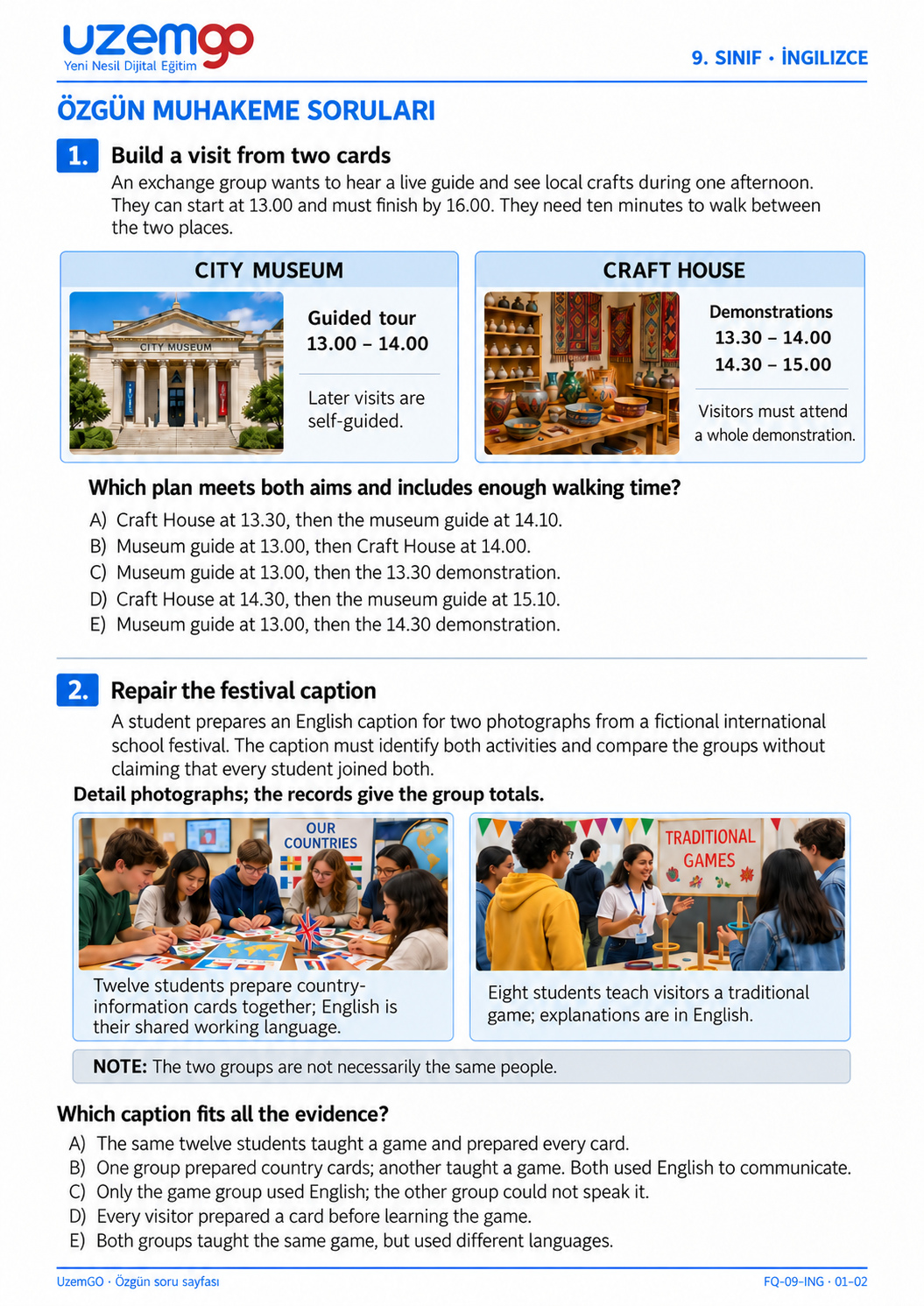
1. Build a visit from two cards
An exchange group wants to hear a live guide and see local crafts during one afternoon. They can start at 13.00 and must finish by 16.00. They need ten minutes to walk between the two places.
Görseldeki bilgiler: İki gezi kartı. CITY MUSEUM: Guided tour 13.00–14.00; later visits are self-guided. CRAFT HOUSE: Demonstrations 13.30–14.00 and 14.30–15.00; visitors must attend a whole demonstration.
Which plan meets both aims and includes enough walking time?
Craft House at 13.30, then the museum guide at 14.10.
Museum guide at 13.00, then Craft House at 14.00.
Museum guide at 13.00, then the 13.30 demonstration.
Craft House at 14.30, then the museum guide at 15.10.
Museum guide at 13.00, then the 14.30 demonstration.
2. Repair the festival caption
A student prepares an English caption for two photographs from a fictional international school festival. The caption must identify both activities and compare the groups without claiming that every student joined both.
Görseldeki bilgiler: İki fotoğraf ve altında kesin kayıt kartı. PHOTO 1: Twelve students prepare country-information cards together; English is their shared working language. PHOTO 2: Eight students teach visitors a traditional game; explanations are in English. NOTE: The two groups are not necessarily the same people. Fotoğraflar grupların tamamını değil etkinliklerden ayrıntı gösterir. Fotoğrafların üstünde şu açıklama basılsın: “Detail photographs; the records give the group totals.”
Which caption fits all the evidence?
The same twelve students taught a game and prepared every card.
One group prepared country cards; another taught a game. Both used English to communicate.
Only the game group used English; the other group could not speak it.
Every visitor prepared a card before learning the game.
Both groups taught the same game, but used different languages.
3. An introduction for a purpose
An exchange student introduces herself: “I live in Ankara, but I was born in İzmir. I speak Turkish and English. I joined this project because I want to compare how students use public spaces.” The project leader needs a sentence explaining her reason for joining, not her birthplace or languages.
Which sentence meets that purpose?
She hopes to compare students’ use of public spaces.
She was born in the city where she currently lives.
She joined only to learn her first English words.
She has already studied every public space in Ankara.
She wants to move all students to the same city.
4. Read the exception
Library notice: Students may use the discussion room after lessons. On exhibition days it is reserved for visitors until five. Today is an exhibition day. A group wants to discuss its project at four.
Which conclusion follows from the notice?
The room is closed permanently to students.
The group can enter at four because lessons have finished.
Visitors must leave whenever a student arrives.
The usual permission does not apply at four today; the group needs another place or a later time.
The exhibition has been cancelled because the room is reserved.
5. Describe without assuming
Two photographs show a school garden. In the first, pupils are putting labels beside plants. In the second, a different group is discussing a sketch of a seating area. No date or result is given. A draft says: “Every pupil rebuilt the whole garden in one day.”
Write a two-sentence caption that identifies both visible activities without claiming a completion time or involving every pupil.
6. The nearest entrance is not always usable
A visitor is at the east gate of a school. The exhibition is near that gate, but the gate is locked during lessons. Visitors must enter through the west gate and follow the marked indoor corridor. The visitor arrives during a lesson.
Which direction is both relevant and permitted?
Use the east gate because it is closest to the exhibition.
Go to the west gate, then follow the marked corridor inside.
Wait inside the locked east gate until someone notices you.
Walk through any classroom window to save time.
Leave the school because all entrances are closed.
7. Whose idea is it?
“The volunteers told the designer that they needed a place for unfinished models. She added a shelf to the plan and sent it back to them for comments.”
Which interpretation correctly follows the references?
The designer told the volunteers that she needed their finished models.
The volunteers sent a shelf to the designer before any plan existed.
She refers to a volunteer, and them refers to the models.
It refers to the shelf as a parcel delivered to the school.
The designer revised the plan in response to the volunteers’ need and asked for their feedback.
8. Make the request complete
Your class wants to use a workshop next Tuesday. The room is available, but the coordinator needs to know the number of pupils and whether you need drawing materials. Your group has twelve pupils and will bring its own materials.
Complete the request: “Could we use the workshop ______? There will be ______, and ______.” Include the details that prevent the coordinator from having to ask again.
9. A comparison with different aims
The town guide describes two places. The archive provides documents that visitors can read quietly. The open-air stage hosts live performances but has no document collection. Eda wants to examine old letters, while Kenan wants to hear live music.
Which recommendation uses each person’s purpose?
Both should go to the stage because every public place stores letters.
Eda should go to the stage and Kenan to the archive.
Eda should visit the archive; Kenan should check the stage’s performance programme.
Neither place can serve any educational purpose.
Both should visit the archive because live music always takes place there.
10. A change, not a contradiction
“Our class normally meets in Room 12. While the ceiling is being repaired this week, we are using Room 8. The timetable has not changed.”
Which summary preserves the temporary change and the unchanged element?
The class has changed its room permanently and has a new timetable.
The ceiling repair means there are no lessons this week.
Room 8 has always been the class’s normal room.
The timetable changed because the repair finished last week.
The class is temporarily in Room 8, with lessons at the usual times.
11. Three requests, three services
Requests: 1. “I need to know what was on this street a century ago.” 2. “I need a quiet place to work with my own notes.” 3. “I want to ask a local craftsperson about their techniques.” Services: A. A reading room with individual desks. B. A workshop visit with time for questions. C. An archive with dated maps and photographs.
Match each request with the best service. Explain why a quiet room alone does not answer request 1.
12. A useful follow-up
A guide says the new community centre is open every weekday. Visitors can join some activities without booking, but workshops have limited places. The leaflet does not identify which events are workshops.
What should a visitor ask before deciding to attend without booking?
Which activities require a booking, and is the event I want one of them?
Why are all weekday activities cancelled?
How can I enter on Sunday when every event is free?
Why does nobody use the community centre?
Can I assume that limited places mean unlimited attendance?
13. What does accessible mean?
“The team made its school map more accessible. It added a clear text description for people who could not use the picture and simplified the labels for newcomers.”
In this context, accessible means —
closer to the team’s favourite café.
available only to experienced map readers.
easier for people with different needs to use and understand.
more expensive because extra details always cost more.
unchangeable after its first version.
14. Separate a plan from a result
A student committee plans to place benches beside a shaded wall. It hopes more pupils will use the garden at lunch. The benches have not yet been installed. A draft report says, “The new benches have already increased garden use.”
Rewrite the report in two sentences that distinguish the proposed action from its hoped-for effect.
15. Different choices, a shared task
Students are choosing a building to introduce to visitors. Some prefer an old station, while others prefer a modern sports centre. The teacher says, “You do not have to choose the same building. Explain which feature makes your choice worth visiting, and support your explanation with a photograph or a note from your visit.”
What matters most in the teacher’s instruction?
Making all students agree that the oldest building is best.
Avoiding modern buildings because they have no useful features.
Choosing the most popular building without explaining why.
Giving a reason for a personal choice and connecting it to evidence.
Replacing a visit with an invented story about a building.
16. A sequence of feedback
A. After reading those comments, we changed the labels. B. We first asked three new pupils to use our draft map. C. Only after the revision did we publish the map for the whole school. D. They marked places where the draft was unclear and sent us their comments.
Write the coherent order. Explain how “those comments” and “the revision” connect the steps.
17. A welcoming message with useful details
A new pupil asks how to join the school newspaper. New members may attend Monday’s meeting at lunch in Room 6. No finished article is required; members may bring one topic idea.
Write a short reply that gives the meeting details and removes the pupil’s worry about needing a finished article.
18. Evidence about a place
A class visited the same square twice. On market day it was crowded; on a weekday without a market it was quiet. The notes include no other visits.
Which statement best reflects the evidence?
The square is always crowded because markets exist.
The two visits suggest that activity in the square can vary with the occasion.
Crowds are caused only by the number of benches.
The square is never used on weekdays.
The notes prove that nobody enjoys quiet squares.
19. Complete an accurate contrast
The first school tour explained the names of rooms but gave pupils no time to ask questions. The revised tour is shorter, but it ends with a question session. Its aim is to make sure newcomers can clarify what they did not understand.
Complete: “Although the revised tour is ______, it gives newcomers ______, which supports the aim because ______.”
20. Write a correction that helps
A notice wrongly directs visitors to the sports hall for a student exhibition. The exhibition is in the art room; the sports hall is being used for practice. The entrance time, 14.00, is unchanged.
Write a correction notice that identifies the changed detail, keeps the time and avoids suggesting that practice or the exhibition is cancelled.
Şimdi sıra sende.
0 / 20 incelendi
1
Çoktan seçmeli
Build a visit from two cards
2
Çoktan seçmeli
Repair the festival caption
3
Çoktan seçmeli
An introduction for a purpose
4
Çoktan seçmeli
Read the exception
5
Açık uçlu
Describe without assuming
Write a two-sentence caption that identifies both visible activities without claiming a completion time or involving every pupil.
6
Çoktan seçmeli
The nearest entrance is not always usable
7
Çoktan seçmeli
Whose idea is it?
8
Kısa yanıt
Make the request complete
Complete the request: “Could we use the workshop ______? There will be ______, and ______.” Include the details that prevent the coordinator from having to ask again.
9
Çoktan seçmeli
A comparison with different aims
10
Çoktan seçmeli
A change, not a contradiction
11
Eşleştirme
Three requests, three services
Match each request with the best service. Explain why a quiet room alone does not answer request 1.
12
Çoktan seçmeli
A useful follow-up
13
Çoktan seçmeli
What does accessible mean?
14
Açık uçlu
Separate a plan from a result
Rewrite the report in two sentences that distinguish the proposed action from its hoped-for effect.
15
Çoktan seçmeli
Different choices, a shared task
16
Sıralama
A sequence of feedback
Write the coherent order. Explain how “those comments” and “the revision” connect the steps.
17
Açık uçlu
A welcoming message with useful details
Write a short reply that gives the meeting details and removes the pupil’s worry about needing a finished article.
18
Çoktan seçmeli
Evidence about a place
19
Kısa yanıt
Complete an accurate contrast
Complete: “Although the revised tour is ______, it gives newcomers ______, which supports the aim because ______.”
20
Açık uçlu
Write a correction that helps
Write a correction notice that identifies the changed detail, keeps the time and avoids suggesting that practice or the exhibition is cancelled.
Yanıtların bu tarayıcıda saklanır. Açık uçlu yanıtlarını örnek cevap ve ölçütlerle sen değerlendirirsin. Bu çalışma resmî sınav puanı üretmez.